


A one-star review feels personal, and the instinct to defend yourself is strong. But the reviewer is rarely your real audience — the hundred or so people who read that review afterward are. How you respond to negative Google reviews determines whether a bad experience becomes a footnote or a permanent stain on your listing, and the difference usually comes down to a handful of specific choices you make in the first few sentences.
Why your response matters more than the review itself
Most people assume a negative review is the damage. In practice, the review is just the headline — your response is the story people actually read to decide whether they trust you. Consumer review research consistently shows that shoppers are far more forgiving of an occasional bad review than they are of a business that ignores it, argues with the customer, or disappears from the conversation entirely.
That is good news: unlike the review itself, your response is something you fully control, every single time.
of consumers say they are more likely to use a business that responds to every review, according to annual consumer review surveys.
of consumers are put off specifically by generic, copy-pasted responses — a thoughtful, specific reply matters more than a fast, hollow one.
is roughly the outer limit most consumers expect a business to take before replying to a review at all.
Figures reflect widely reported findings from annual consumer review and local search behaviour surveys; exact percentages vary by year and source, but the direction has held consistently.
The 5-step framework for responding to a negative review
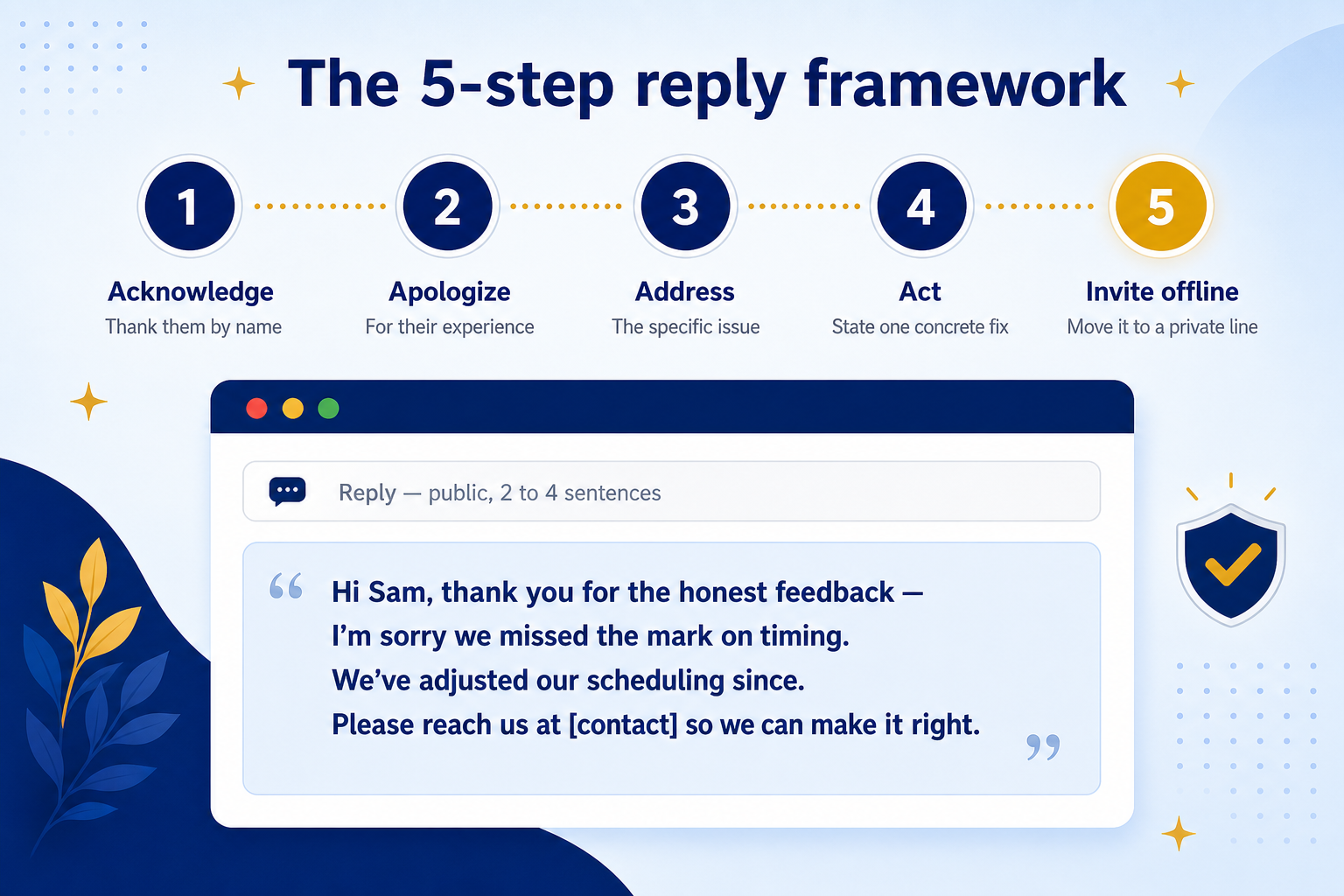
You do not need a different strategy for every complaint. Almost every negative review can be handled with the same five-step structure — adjust the tone and detail to the situation, but keep the order.
- Acknowledge and thank them. Use the reviewer's name if it is available and thank them for taking the time to leave feedback. This single sentence does more to de-escalate than anything else you will write.
- Apologize for their experience, not necessarily for being wrong. "I'm sorry your visit didn't meet expectations" is honest even if you dispute the details — it acknowledges their feelings without conceding a fact you disagree with.
- Address the specific issue briefly. Reference what they actually mentioned (a wait time, a miscommunication, a product issue) in one sentence, so readers can see you actually read the review rather than pasting a template.
- State what you are doing about it. A concrete, small action — "we've adjusted our scheduling process" or "I've spoken with the team about this" — signals the problem is being taken seriously, not just apologized for.
- Invite them to continue the conversation privately. Give a direct phone number or email and ask them to reach out. This shows every future reader that you are willing to make things right, even if the original reviewer never takes you up on it.
Reply templates you can adapt
These are starting points, not scripts — always personalize with the reviewer's name and the specific detail they mentioned.
Service was late or missed
"Hi [Name], thank you for the honest feedback, and I'm sorry we missed the mark on timing for your appointment. That's not the standard we hold ourselves to, and we've since adjusted our scheduling to prevent this happening again. I'd like the chance to make it right — please call or email us directly at [contact] so we can follow up personally."
Complaint about quality
"Hi [Name], thanks for taking the time to share this. I'm sorry the [product/service] didn't meet your expectations — that's genuinely useful feedback and we've flagged it with the team. If you're open to it, we'd love the chance to put things right; feel free to reach us at [contact] whenever suits you."
Misunderstanding or wrong business
"Hi [Name], thank you for the feedback. We want to make sure we've got the full picture, and a couple of details here don't match our records for that date — would you mind reaching out to us directly at [contact] so we can look into this properly? We take every review seriously and want to resolve this."
Suspicious or clearly fake review
"Hi, we take all feedback seriously, but we're unable to find any record of this visit/order under this name. We'd welcome the chance to look into it further — please contact us directly at [contact] with any order or booking details you have."
What not to do when responding to a negative review
The fastest way to turn a single bad review into lasting damage is a bad reply. A handful of mistakes account for almost every review response that backfires publicly.

When you can (and can't) get a review removed
Google will only remove a review if it violates its review policies — think spam, hate speech, conflicts of interest, or a review clearly left about a different business. A genuine complaint about slow service or a product that did not meet expectations, however unfair it feels, will almost never qualify for removal, even if you offer a refund afterward.
If you believe a review is fake or violates policy, flag it through your Google Business Profile and post a brief, calm public reply at the same time. Waiting weeks for a flag to be reviewed while leaving the review unanswered lets it sit there doing damage in the meantime.
How to stop one bad review from sinking your reputation
The single best defense against any individual negative review is context — a visible, healthy history of other reviews that makes one bad experience look like exactly what it usually is: an outlier. A business with three total reviews and one bad one looks 33% negative. A business with eighty reviews and one bad one barely registers.
- Keep asking every satisfied customer for a review — volume and recency are your best insurance against any single complaint carrying too much weight.
- Show your reviews on your own website, not just on your Google Business Profile, so visitors see your overall rating and recent proof without having to go looking for it themselves.
- Respond to positive reviews too — a business that only replies when things go wrong looks reactive rather than genuinely engaged with customers.
- Monitor for new reviews regularly so you can reply within a day or two, before a review has time to sit unanswered.
This is exactly why an auto-syncing Google review widget is worth having even if your rating is already strong: it puts your genuine track record front and center, so a single low-star review reads as one data point among dozens, not the whole story. GR Widget syncs your Google Business Profile automatically with 10 layouts free and 17 in total across paid plans — no API key, no manual screenshots to update after every new review. If you have not linked a listing yet, start with our guide on setting your Google location for reviews.
Curious how many reviews visitors actually look at before trusting a business enough to book? Our guide on how many Google reviews customers read before booking breaks down the research. Installing on WordPress specifically? See the WordPress embed guide, or the Google reviews embed guide for any other CMS or hand-coded site.
Quick checklist: responding to a negative review
- Reply within a day or two — a week at the absolute latest
- Use the reviewer's name and reference their specific complaint
- Thank them and apologize for their experience, without necessarily admitting fault on disputed facts
- State one concrete action you are taking, then invite them to continue the conversation offline
- Keep the public reply to two to four sentences — resolve details privately
- Flag genuinely fake or policy-violating reviews, but still post a brief public reply while you wait
- Keep collecting new reviews so no single bad one carries outsized weight
Frequently asked questions
How do you respond to a negative Google review?
Acknowledge the reviewer by name, thank them for the feedback (yes, even a harsh one), briefly address the specific issue without getting defensive, state what you are doing about it, and invite them to continue the conversation privately by phone or email. Keep the public reply short — two to four sentences is usually enough. The goal is not to win an argument with one reviewer; it is to reassure the next hundred people who read it.
Should I respond to every negative review, even unfair ones?
Yes. Future customers read your responses far more than they read the original complaint, and an unanswered negative review often looks worse than one with a calm, professional reply — even if the reviewer never changes their mind. If a review is clearly fake, abusive, or violates Google's policies, you can still reply briefly and flag it for removal at the same time; do not simply ignore it and hope it disappears.
Can I get a negative Google review removed?
Only if it violates Google's review policies — for example, it contains hate speech, spam, conflicts of interest, or is about a different business entirely. Genuine complaints about your service, even harsh ones, will not be removed just because you disagree with them or offer a refund. Flag suspicious reviews through your Google Business Profile, but plan to respond to legitimate criticism rather than waiting on a removal that may never come.
How quickly should I respond to a negative review?
Within a day or two if possible, and within a week at the absolute latest. Consumer trust research on review response behaviour consistently finds that people expect a reasonably fast reply, and a business that takes weeks to respond (or never does) sends a signal that feedback goes unheard. Setting up notifications on your Google Business Profile, or using a widget that shows recent activity, makes it much easier to catch new reviews quickly.
Is it okay to offer a refund or discount in a public review reply?
Be careful with specifics. Naming a dollar amount or exact offer publicly can invite other reviewers to ask for the same thing regardless of their situation. It is safer to say you would like to make it right and ask them to reach out directly, then handle the specific resolution — refund, discount, redo — in a private conversation.
Does responding to negative reviews help local SEO?
It can help indirectly. Google has said review responses are a factor it can take into account for local search and Maps ranking, and active management of your Google Business Profile is generally associated with better local visibility. Just as importantly, thoughtful responses keep your overall rating and reputation strong, which supports every other local SEO effort you make.
Let your whole track record answer with you
A careful public reply handles one complaint. GR Widget puts your live Google reviews on your website so that one low star sits in context, not as the whole story.
No charge for 7 days. Cancel before then to avoid the first payment of $5.99/month for Site or $14.99/month for Business.